
Thinking about adding a barn door to your home? Good news: you really can install barn doors without turning it into a week-long renovation. With the right hardware, one person can usually knock this out in an afternoon. Here’s exactly how to hang a sliding barn door in five straightforward steps.

Note: The simplest “can’t-mess-it-up” approach is using an all-in-one door + track kit. The components are already matched for sizing and weight, the instructions tend to be clearer, and it often ends up being cheaper than piecing parts together separately.
Step 1: Measure the Doorway Opening
Start by measuring the opening (width and height). Most interior doorways are roughly 80″ tall and 28″–36″ wide. A hinged door fits inside the opening, but a barn door needs to overlap the opening so it actually covers it.
A good sizing rule is to add 2–4 inches to the opening width and 1–4 inches to the opening height. That overlap helps reduce gaps and gives the door better coverage for privacy.
Example: If your opening is 30″ × 80″, you’ll typically want a barn door around 32″–34″ wide and 81″–84″ tall.
- Width: 32–34 inches (30 inches + 2–4 inches)
- Height: 81–84 inches (80 inches + 1–4 inches)
Step 2: Choose a Track Kit That Fits Your Door
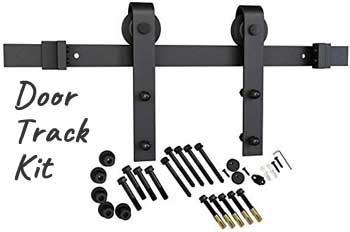
Your track kit is what makes the whole system run smoothly. A typical kit includes the rail, hangers/rollers, bolts, spacers, and end stoppers. The key is choosing one rated for your door’s width and weight.
Most listings tell you exactly what door size range and weight capacity they support—so check those details before buying. If you want less guesswork, kits tend to be the easiest route because everything is designed to work together.
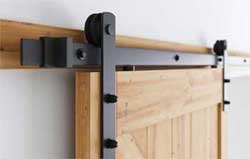
For most single interior barn doors, a 6′6″ track is a common fit. Wider openings may require a longer rail so the door can slide far enough to fully clear the doorway.
Step 3: Mount the Track to the Wall
Hold the rail above the opening and use a level to make sure it’s perfectly straight. This step matters—if the rail is slightly off, your door will roll open or closed on its own.
Next, locate studs with a stud finder and fasten the rail into the framing whenever possible. Solid anchoring is what keeps the door stable and quiet over time.
How do you hang a sliding barn door without studs? If a rail hole doesn’t line up with a stud, use the wall anchors included with many kits. Another reliable option is mounting a header/backer board into studs first, then attaching the rail to that board.
Step 4: Install the Hangers on the Door
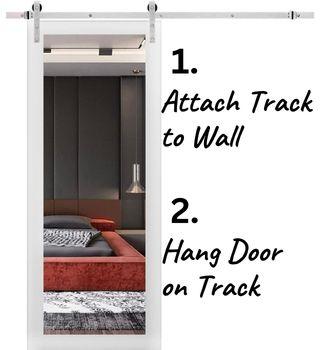
Using the kit’s template (or measurements provided), bolt the hangers/rollers onto the top of the door. Keep everything square, then check your floor clearance. A common target is roughly ¼ inch so the door glides freely without scraping.
Once the hangers are secure, lift the door and hook the rollers onto the rail. Slide it back and forth a few times to confirm it rolls smoothly and sits evenly.
Note: If your door slab is unfinished wood, stain/paint/seal it before adding hardware. It’s cleaner, easier, and you won’t have to work around rollers and bolts later.
Step 5: Add Door Stoppers and a Floor Guide
Finish strong with the safety and stability parts. Install a stopper at each end of the rail so the door can’t roll off the track. Then mount the floor guide at the base so the door stays aligned and doesn’t sway as you slide it.
To complete the setup, add barn door handles for easier operation and, if needed, a privacy solution with barn door locks.
Frequently Asked Questions
Do I need a header board (backer) for a barn door track?
Not always, but it can make installation easier—especially if your studs don’t line up well with your rail holes. A backer board also adds a finished, intentional look.
How much space do I need above the door for the track?
It depends on the kit, but most require several inches above the opening to fit the rail and rollers. Check the product listing instructions for the exact clearance.
Why does my barn door wobble at the bottom?
That’s almost always a missing or poorly placed floor guide. The floor guide is what keeps the door from swinging in and out when you move it.
Can one person hang a barn door alone?
Yes, especially with a lightweight slab—but having a second person helps when lifting the door onto the rail and making final adjustments.
Reputable Resources for More Information
- This Old House – Interior door and hardware installation basics
- Family Handyman – DIY door projects, stud-finding, and mounting tips
- Fine Homebuilding – Best practices for anchoring into framing
Conclusion
Hanging a sliding barn door is one of those upgrades that looks dramatic but doesn’t have to be complicated. Measure for proper overlap, choose a track rated for your door, mount the rail level into solid framing, and don’t skip the stoppers and floor guide. Once it’s up, add handles (and a lock if you need privacy), and you’ll have a smooth-gliding door that feels like a pro install.